
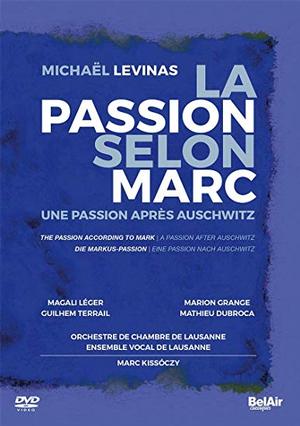
PASSION ACCORDING TO MARK: LAUSANNE (KISSOCZY)
Title
PASSION ACCORDING TO MARK: LAUSANNE (KISSOCZY)
SKU
5511094
Catalogue No.
BAC552
UPC
3760115305526
Label
Genres
Release Date
Apr 1, 2019
Format
Blu-ray
Packaging
Blu-Ray Case
No. of Discs
1
Region Coding
A,B,C (Blu-Ray)
TV Standard
1080p
Weight
0.34
Price
$51 inc. GST
Ships From
Melbourne, AU
The Passion according to Mark-A Passion after Auschwitz, premiered in April 2017. The project was commissioned to French composer Michael Levinas by the Swiss association Musique pour un temps present, as part of the events commemorating the 500th anniversary of Luthers reform. This original oratorio is not only a reinterpretation or a mere revisitation of the Passion, it painfully faces, indeed, the irreconcilable nature of the Passion and the Holocaust. What is the object of this Passion after Auschwitz, which revolves around what can link two musical traditions, two religions that have been separated by barbarism. Which music, which tradition, which language can the composer use in order to express this double silence, both historical and theological, both human and divine? After the Holocaust, is it possible to compose without crying and trembling?, Michael Levinas asks. It is not about anger or compassion. Because of the subtle polyphonies written for the chorus, the voices and the orchestra, and also because of the way the different languages - Old French, Yiddish, Aramaic, German - create meaning out of one another, both the structure and the musical language of this Passion are incredibly intricate. But they are so for a reason: by putting side by side western musical traditions and the tragic component of modern history, Levinas manages to shake, during the artistic process, the future of the Holy Language and of the Gospel after Auschwitz. What separates therefore the Gospel of Mark from the Jewish prayer for the dead (Kaddish) or from the El male Rahamim, or from the two poems by Paul Celan ending the work, is not so much a question of representation, but more accurately it is a way to make the tragedy resound, without any artifice and without any safety net.
'The Passion according to Mark-A Passion after Auschwitz,' premiered in April 2017. The project was commissioned to French composer Michael Levinas by the Swiss association Musique pour un temps present, as part of the events commemorating the 500th anniversary of Luther's reform. This original oratorio is not only a reinterpretation or a mere revisitation of the Passion, it painfully faces, indeed, the irreconcilable nature of the Passion and the Holocaust. What is the object of this Passion after Auschwitz, which revolves around what can link two musical traditions, two religions that have been separated by barbarism. Which music, which tradition, which language can the composer use in order to express this double silence, both historical and theological, both human and divine' After the Holocaust, is it possible to compose without crying and trembling', Michael Levinas asks. It is not about anger or compassion. Because of the subtle polyphonies written for the chorus, the voices and the orchestra, and also because of the way the different languages - Old French, Yiddish, Aramaic, German - create meaning out of one another, both the structure and the musical language of this Passion are incredibly intricate. But they are so for a reason: by putting side by side western musical traditions and the tragic component of modern history, Levinas manages to shake, during the artistic process, the future of the Holy Language and of the Gospel after Auschwitz. What separates therefore the Gospel of Mark from the Jewish prayer for the dead (Kaddish) or from the El male Rahamim, or from the two poems by Paul Celan ending the work, is not so much a question of representation, but more accurately it is a way to make the tragedy resound, without any artifice and without any safety net.